Tuesday, August 8, 2017

Florida Workers Compensation (Part 1) - What they don't want you to know.

If you are here, it is because you are looking for information on how Workers' Compensation works in Florida.  This is going to be a little different than me selling my services giving you a slight overview of workers' compensation and asking you to call.  Nevertheless, if you want to have your work comp case handled, you can call me at 904-383-7448.  I generally pick up the phone- but I won't be interested in giving you any more free advice than below.  I wanted to hit the top 10 issues that I see on a daily basis.   I practice in Jacksonville, Florida.

For the past year and a half, I have been working for a high volume large firm handling only workers' compensation cases.  This is based on my experience and is not to be construed as legal advice- although I will be dealing with the questions where most people have asked for advice.

The only thing that the insurance company has to do is give you the benefits of the policy.  They can always decide that they don't want to give you a lump sum settlement.


1.  Money or Doctors?  To settle or not to settle.

Settling your workers' compensation case in Florida is as easy as taking a check to the bank, if that process involved getting three people, two witnesses, and judicial approval.  If you wanted to settle your work comp case from $500 to $2000, it could be finished tomorrow.  If you want more, you will have to let your attorney build his case and try to see what he can get for you.  If the insurance company has made an offer, you can accept it and place it in the bank.  

You don't have to settle your case.  But, with the substandard doctors, poor care, and bureaucratic red tape, most everybody in workers' compensation will tell you that you will get better care using your own money and selecting your own doctors.  (Yes, in Florida, the insurance company picks your doctors.)  


            1a.  Will I have to lose my job if I settle?

99% of the time, if you settle your case in Florida you must also resign from your employer.  The largest exception to this is Walmart, who notoriously does not require a resignation to settle a work comp case.  The other exception, is if your employer has hired a new or different Work Comp Insurance carrier between your accident and the current date.  Technically, if you employer wanted to still employ you after settlement, it would be advisable for your employer to find a new insurance company and to enter into a new written agreement for employment.

            1b.  How much is my case worth?

Probably less than you think.  When looking at a workers' compensation case, the insurance company does an analysis based on your expected treatment, whether or not you need surgery, how long you would be out of work.  In essence, they are asking "How much is this person going to cost me if we treat them fully for their injuries?"  With differing injuries, you would get different results.  Someone who needs an outpatient knee surgery is going to have less of a case value than someone who needs a inpatient back fusion.     

There are multiple reasons for this price difference.  First is that an inpatient procedure costs much more than an outpatient procedure.  Also, the recovery time for an inpatient procedure is bound to be longer than the recovery time for an outpatient procedure.  They look at all the potential costs that they must bear if they were to see you all the way to your maximum medical improvement.  This is called MMI, and it generally signals the end of your treatment with physicians.

It is possible that someone who needs a back fusion has not suffered as much as someone who needs a knee arthroscopy.  This does not matter to the insurance company.  They do not pay for pain and suffering.  Again, they do not pay for pain and suffering.  Generally, you will find that the insurance company will inflict pain and suffering, sometimes purposefully, by denials of operations, prescriptions, etc.  The work comp insurance company issue denials to help out their profit margin and to put Porsche's in their driveways.   Before you raise your voice at me, and try to tell me that your employer created such an unsafe condition, I can only explain that worker's compensation does not care.    

There are exceptions to this rule.   Florida Statutes 440.011(1)(b) lists the requirements for a direct suit over and above worker's compensation.  These are generally impossible to prove except in the worst of circumstances, and 999/1000 times, your case does not fall into this category.  One court has allowed an injured worker to sue his employer when the employer did not report an accident and caused the employee to fail to timely file a claim.   Ocean Reef Club, Inc. v. Wilczewski, 99 So.3d 1 (Fla. 3d DCA 2012).  Again, you likely do not fall under these exceptions.

            1c.  But my surgery would cost $60,000 - I looked it up.  You're telling me that they wont pay me $60,000?

If you walked in off the street, without insurance, your surgery might cost $60,000.  However, the insurance company negotiates lower rates and some procedures are set out by statute are fixed by a reimbursement schedule set forth by our legislature.  https://secure.fldfs.com/wcapps/cpt/ProviderManMenu16.asp   So, even though your surgery might run in the range of $60,000, it is possible and even likely that if worker's compensation would only need to pay $20,000 for the surgery.  

Why would it ever make sense to settle your case then, if you needed surgery?  Currently, under the Affordable Care Act, you can apply for health insurance that will cover preexisting conditions.  If they were facing costs of $20,000 for your surgery, and would offer you $20,000 to settle your case, you could use that money, obtain insurance, and treat your conditions with the doctor of your choosing.


2.  I have been offered light duty from my employer / my employer has no light duty.  What should I do?

If your employer has offered you light duty, you should accept it.  Why?  Because work comp does not have any duty to pay you indemnity checks if you reject an offer of light duty.  Indemnity checks are only two thirds of your expected paycheck.  Most people find it difficult to live when their income is cut by a third.  Remember, they do not pay for pain and suffering.

But my employer has no light duty!  When a client says this to me, the first thing I generally ask is, "How do you know?"  Generally my client will launch into a giant discussion about how "The only thing that they do at my company is  ______________, and because of my injury, there is no way that they would let me do ____________."

Call your employer- ask about light duty availability.  If they tell you that none is available, you should be receiving checks from work comp.  If they tell you that some is available, then you should report to work or else you forfeit your indemnity checks.

          2a.  But I only work in the area of __________, but they are having me do desk work.  This is not what I signed up for!  I'm supposed to be doing __________.

Tough.  If they want to make you the designated toenail clipper, and it is within your light duty restrictions, you must comply with their light duty requests or else you forfeit your right to indemnity checks.  

         2b.  I don't want to work there anymore, I just want to quit.  Will this hurt my case?

In general, I always advise my clients to do whatever it is that they need to live.  No one should ever think that their work comp case is going to set them up for the rest of their lives.  If you have another job lined up, and you want that job and it will make your life better- then go ahead and quit.  None of the benefits that you would gain by staying employed with your employer after your work injury can equal the benefit of being in a good job that you love.

3.  I don't want surgery, I don't want money, I just want to be better!

Personally, I find that many of my clients are offended when I ask if they want money rather than doctors.  The discussion generally starts like this, "So you want to try and get money out of the case rather than doctors?"

The client generally chimes back saying "I'm not in this for the money, I just want to get better."  Often times there is a slight undertone of offense that I would only think that they are looking for a payday.

This offends me on two levels.  First, is the incorrect assumption that I would think less of a client who wanted to get cash and get out of worker's compensation.  Second, is the incorrect assumption that if they get money, they would not be able to get better.
It is a fundamental truth, that you will have better doctors, a wider range of care options, and a generally higher level of care with doctors outside of work comp.  
         3a.  I don't want surgery, I just want money!

By telling them you don't want surgery, you have just lowered the amount that the insurance company expects to pay on your case.  You want surgery, or money.  You want surgery, or money.  You want surgery, or money.


4.  My bi-weekly indemnity checks stopped- my surgery was not authorized- my prescription was not authorized, what can I do?

Generally, these are the issues that cause more people to hire an attorney more than any thing else.  Before you hire an attorney, try calling your adjuster.  They are the folks that need to approve all benefits that are paid.  If they refuse, then it would be up to you to hire an attorney or to file your own petition for benefits yourself.  If you don't hire an attorney to file your petition for benefits, make sure you have all medical records from your case.

Thursday, July 30, 2015

Florida Revenge Porn Lawsuits - Sue the bastards

NO LONGER FEEL LIKE A VICTIM


Frankly, there are not many situations where I would use the phrase "Sue the bastards," however when it comes to pornography of your sons or daughters posted online.... Sue the bastards.


Criminal Prosecution

Criminal prosecution is generally what people think of when they want to right a wrong, or imagine a trial on the matter.  Criminal prosecution involves the police, and the State Attorney's office, and generally punish offenses against the state and the individuals which prescribe the state.

Beginning October 1st, Florida will be under the control of 784.049, Florida Statutes which makes it a misdemeanor to commit sexual cyberharassment, and a felony for repeat offenders.   The proper avenue for getting criminal actions begun is to contact your local police department.  Generally, they will work with local prosecutors to get these cases to the point where the offender will be brought before a judge and punished.  Misdemeanors are punishable by up to a year in jail.


Civil Prosecution

Civil prosecution of this kind of case is also governed by 784.049.
(5)  An aggrieved person may initiate a civil action against a person who violates this section to obtain all appropriate relief in order to prevent or remedy a violation of this section, including the following:
(a)  Injunctive relief.
(b) Monetary damages to include $5,000.00 or actual damages incurred as a result of a violation of this section, whichever is greater.
(c) Reasonable attorney fees and costs.
Section (a) regarding injunctive relief is seeking a court order forcing the person to remove the image from the website, to delete the images wherever they may exist, and to prevent any future posting or use of the image.

Section (b) is the civil penalty associated with the act of harassment.  The $5,000 number represents a minimum penalty in the absence of genuine damages.  Damages to reputation, business, or other such damages are difficult to calculate and therefore difficult to ascertain.  However, if the nude picture somehow damaged someone financially in excess of $5,000.00, those damages could also be recoverable.

Section (c) provides that you should be entitled under the law to recover fees and costs associated with the lawsuit that you file to take down the offending material.  This means that if you file a lawsuit, and are successful in the prosecution of the suit, you will be entitled to get every penny back that you reasonably paid to an attorney to get your results achieved.

Graham is Ready to Take Your Case

Finding an attorney to take on a new type of case under a new law is sometimes difficult.  You have to call up offices, wait for a call back, then get a quote, etc. etc. etc.  Graham loves new cases, and is specially positioned to take these cases immediately.

The law office of Graham W. Syfert at 904-383-7448, will be taking on civil cases regarding online pornography, and will pursue them passionately.  Graham has a background in technology, IP networking, and was previously a system administrator for a research firm.   Our goal is to find the bastard, terrorize the bastard, and sue the bastard.

The flat fee associated with removing of pornographic images from website will be $1500.00 with about $500.00 of that used for the costs of suit.  Graham W. Syfert, P.A. will make every effort to recover every penny you pay in fees or costs, and return your life to where it was before this ever happened.


Saturday, June 20, 2015

PDF Metadata in the Practice of Law


Clerk Seeks Indemnification for Metadata Disclosures

The Florida Bar has released an article which states:

 "Florida Court E-Filing Authority, which manages the statewide e-filing portal, that it include a warning on the page where filers designate the type of document they are filing. That notice will read: “Warning: Removal of document metadata is the responsibility of the filer. Any document metadata remaining may become part of the public record.”
The idea is that an identity thief, fraudster, et cetra may obtain metadata from a filer failing to scrub PDF documents after redactions, and obtain SSN's, credit card numbers.
Is the Florida Court E-Filing Authority a clerk of court?  They seem to fill the role.  Or are they as "Pacer" is to the Federal Clerk?

The article goes on to note that only 37% of online filers create searchable PDF's.  Wow.
I'm curious as to how many untold gigs of storage is wasted by clerks of court.

Metadata's potential usefulness, apparently, caught the clerk, and by inferrence some judges by surprise:

Mary Cay Blanks, clerk for the Third District Court of Appeal stated: 
“All kinds of information was in that document, who the judge was, who the secretary was; everything is in there,” she said. “We realized we had to strip all of that information, which, now we do.”
While it may be a prudent practice to strip such metadata and information from an opinion or an order, shouldn't we be allowed to know these things anyway?  If I were a Plaintiff or a Defendant receiving an order, I might like to know what judge worked on it, or what secretary worked on it.  But

I bet you dollars to donuts that the Clerk of the many DCA's can tell you the exact date and time when a Appellant's lawyer got notice of Oral Argument through the logs of their webserver and unique URL's.  It's a metadata of sorts, as it is not exactly plain on the surface that this information is recorded.   I digress- if you are in a law firm, it is obvious that you should not allow metadata to be shared with opposing counsel, or the public at large.

Redaction of PDF metadata in regards to editing out personal information is a no brainer.  If you draw a box over some text in a PDF, the text remains.  If you redact, do so properly.
https://blogs.adobe.com/acrolaw/2010/06/ricks-guide-to-using-redaction-in-acrobat-x-pro/

Apparently in Linux, if you are not running Acrobat in Wine., there is not much of a good way to redact, except Inkscape Vector Editor:
https://askubuntu.com/questions/72920/is-there-a-better-way-to-redact-a-pdf

If I told you how often I looked at PDF metadata to get ideas about a case, confirm a fact, confirm a filing time, you'd probably get the wrong idea about me.  I have had two cases where I used PDF metadata to figure out what attorney or firm was responsible for the filing or the drafting of the documents.  One of the cases was widely publicized.  The other case was an attorney who continued to file documents on behalf of his client when they substituted in new counsel after a motion to disqualify.

In addition, there have been at least three other cases where I have used PDF metadata to identify a John Doe defendant, or a metadata remnant of a non-attorney created PDF was key in opening up a new strategy.  

The truth is, that advising attorneys to scrub all metadata from a PDF before filing is a little overbroad.  Is it a good practice?  Sure.  But essentially, scrubbing PDF data is kind of destroying the evidence.

As a part of my practice includes criminal defense, I suppose I could advise everyone out there to scrub their metadata.


Saturday, January 18, 2014

Ethics of Facebook, Twitter, and Blogs. Oh, and LinkedIn - For attorneys.


In Florida, among attorneys, there is a crisis of ethics.  No, no, not like that.  Not at all like that.  Well, that's another discussion but I can not necessarily have it on this blog.  Instead, it is the ethics of being able to use websites that normal ordinary people use everyday.

Newly filed is a case that is pending against the Florida Bar of Searcy v. Florida Bar (complaint).  The law firm of Searcy Denny Scarola Barnhardt & Shipley published on their blog comments regarding opinions that were not "objectively verifiable."  Such comments were that the days "when we could trust big corporations . . . are over," and that "[g]overnment regulation of Corporate America's disregard of consumer safety has been lackadaisical at best," and that "when it comes to 'tort reform' there is a single winner: the insurance industry."

The ABA asks, "is Florida too tough on lawyers using linkedin and twitter?"  http://www.abajournal.com/news/article/is_florida_too_tough_on_lawyers_using_linkedin_and_twitter_endorsements_and/

So, what we have is a new form of media, the internet, that we are trying to form into old restrictions on the ability to publish and advertise and communicate that are now being eradicated by the ease of use and openness of the internet.  See Florida Bar Revokes advisory opinion.  It is obvious that the attorneys of Florida are at a crossroads in how exactly to handle the freedom that is provided through ease of rapid communication which is unparalleled in our history and will grow exponentially.

The simple fact is that the internet can be abused by attorneys.  The internet can be abused by anyone.

Twitter

Now I don't handle many personal injury cases, but ambulance chasing is an old lawyer joke.  The image of a lawyer chasing an ambulance is practically unheard of, at least I never hear it.  Instead, they must interrupt Jeopardy and late night Perry Mason episodes to inform us to the sound of boring background music that they are compassionate people who will work hard on your case.  But if one of them decided to ambulance chase on the internet, they could follow individuals in their target area, say, the entire State of Florida, and look for people announcing major life events on twitter.

A search of #CarWreck on twitter, just one of many possible searches, at 10:16 AM on 1/18/2014, yielded evidence of at least four people who had been in car accidents in the last week  An auto responder under could be setup to tweet back at that person, "Hey, I know a great attorney! Call 904-383-7448."

And to blatantly advertise, yes I do handle a small number of select personal injury cases in Florida and Georgia.

Surprisingly, or maybe not surprisingly, two law firms also appear in the search for #carwreck


Now, a lawyer or a law firm simply using a hashtag "#carwreck" is not ambulance chasing, but it is blatant free advertising.  One statement is a boring "objectively verifiable" statement, which if said in the midst of a normal "conversation" would be quite a non-sequitur.  However, searching for a hashtag is a request for information, the same as a website.

If the law firm had tweeted at a Georgia car wreck victim say, "@carwreckvictim Hey, I heard you were in a wreck.  Visit www.syfert.com!" It would be a different story.

Twitter is a place for open conversation.  An attorney should regulate himself on twitter the same as they would over a message board, irc chat room, in a restaurant, on a beach, or walking to the courthouse.  Twitter can exist in two basic ethical states.  Twitter can be information on demand, such as the use of the "#" hashtag.  Or Twitter can be a shouting match, a place to watch the random thoughts of the world fly by, and give you an opportunity to engage in conversation.

This duality is the core of the problem in determining the ethics of twitter.  Another duality that was created, mostly because of Facebook, was a suggestion and/or requirement that there be a clear divide between, well, what is best described as lawyer Graham and citizen Graham.  Despite the fact that I am a solo practitioner and it's very difficult for me to confuse anyone, I still have a second Facebook page for my law firm, separate from my personal Facebook.   Now, what's really bizzare about the split in the firm page and the Facebook page, is that essentially it doesn't matter.  My personal account is linked as the owner of the firm, just as any other member could be linked to the firm.  Essentially, the formation of my corporate structure, and the creation of a separate Facebook page, has done nothing to truly separate myself from this corporate Facebook account.

In this attorney's personal opinion, it is more genuine and ethical for an attorney using social media to be themselves.  Now I don't often hang out in bars unless I'm watching a concert, but if any attorney came forward into a barroom conversation and started saying "Get the recovery that you need and deserve.  Hashtag Website. Hashtag Georgia.  Hashtag Painlaw," it is obvious that the person would get up and walk away.  To forward the cause of what it is to be an attorney, it is again my opinion that the use of firm twitter accounts should be discouraged.  However, it is practically necessary for the purposes of advertisement.

If I were to make a bright line rule, for Facebook, Twitter, and Linkedin, or the internet as a whole, it is simply the same as rules governing an attorney, in public.  A virtual public, to be sure, but public nonetheless.

Facebook, Twitter, Advertising

Social media allows you to be anti-social.  Likewise, social media allows you to be overly-social.

Hiring twelve men with megaphones to shout your name and number from the street corner near the courthouse, would be advertising.

Guerrilla Marketing

Guerrilla marketing can take place either live or automated.  This is essentially ambulance chasing.  Various methods of exploitation of this form of marketing can exist.

Automated marketing could require the hiring of a company, however an attorney with the proper technical knowledge could easily build a server that would script automated responses.  From this one computer, and some clever word manipulation, it could appear that hundreds of people are discussing your law firm or the prowess of your attorneys.  Now, why hundreds of people are discussing your law firm, may become an issue if the story is not believable.  It's obvious that this form of marketing, or direct contact looking for people who were involved in an accident, is an issue.  "Sorry to hear about your accident, #GrahamisTheBestAttorneyEver #GiveHimACall?"

And what if such searching and responding were not robots, but instead people, would they not also be subject to attorney regulation?

There is a problem at this juncture, with search optimization companies, or SEO.  SEO companies have already engaged in both automated and non-automated entries on websites, to boost page rankings of attorneys.  Big money is paid for these links.  I think this is all unethical.

Paid Advertising

Twitter has a character limitation.  However, what is generally desired from a lawyers tweet is a call to action.  "Click this link!"  "Look at me!"  "Pay attention!"  "Over here!"  Its 140 character limitation means that if I include my address and my phone number, like a skeleton ad, I only have 82 more characters left.

The differentiating point of the speech on the internet that should be approved is when the advertising is paid.  If the advertising is paid advertising on another website, whose content is beyond the control of the firm, then such advertising should be scrutinized.  The bar should scrutnize both the "tweet" which would be paid to be a sponsored advertisement, and the webpage that is in the call to action in the tweet.

LinkedIn categories, Customer Reviews

As soon as I saw the LinkedIn categories where people put down that they have specialties, I knew that this was a problem.  When they allowed people to endorse other people for specific categories, I cringed.  However, there is nothing I can do about this.  Like the majority of people, I have a LinkedIn profile, but I do not use it.  Unlike most people, I don't generally use Facebook either.  

I've said it before, it is my opinion that the use of these specialties are unethical.   The endorsements, well, I have little control over that.

Customer reviews are a completely different matter entirely.   I love getting positive feedback from a client.  For all the positive feedback I get from my clients, I sincerely expect more feedback on the Internet.  But that's probably just my ego.  Still, it surprises me quite often to see some, often solo attorneys, with so many positive client reviews.   It doesn't surprise me that the linkedin profiles and the avvo profiles of some of the best attorneys contain no client reviews, no picture, and sometimes incorrect information.

Customer reviews are the first amendment right of a customer.  Endorsements on linkedin are the first amendment right of the customer.  Unless they were solicited or requested, or paid for, they are not content that is subject to attorney regulation.

I think that assigning an attorney a number on a scale of 1-10 is ridiculous.  But I'm also a little nutty on this, because I don't believe the Martindale Hubble system of ranking should be used.  I don't believe it should be allowed to be used in attorney advertising, and I don't believe it should be allowed in general.


Tuesday, June 4, 2013

Sharkmp4 PirateBay logs

| 7529073 |                              
        | 2012-08-13 17:28:41  | 50.77.50.222 |
| 7529137 |        
        | 2012-08-13 17:40:33  | 50.77.50.222 |
| 7529155 |             
        | 2012-08-13 17:47:34  | 50.77.50.222 |
| 7552199 |       
        | 2012-08-21 00:54:51  | 46.21.99.22  |
| 7819909 | 
       | 2012-11-13 01:35:40  | 75.72.88.156 |
| 7825185 |      
        | 2012-11-14 17:14:58  | 75.72.88.156 |
| 7825203 |        
        | 2012-11-14 17:20:48  | 75.72.88.156 |
| 7825260 |      
        | 2012-11-14 17:30:30  | 75.72.88.156 |
| 7832814 |           
        | 2012-11-17 00:31:14  | 46.21.99.29  |
| 7844770 |      
        | 2012-11-20 19:51:42  | 46.21.99.29  |
| 7848258 |                     
        | 2012-11-21 19:46:21  | 46.21.99.29  |
| 7892402 |                                   
        | 2012-12-06 00:56:18  | 46.21.99.29  |
| 7912530 |                         
        | 2012-12-11 19:30:54  | 75.72.88.156 |
| 7936734 |                           
        | 2012-12-19 00:31:27  | 85.17.31.120 |
| 7940008 |   
        | 2012-12-19 23:03:32  | 46.21.99.29  |
| 7968216 |                                      
        | 2012-12-29 01:00:50  | 46.21.99.29  |
| 8119701 |                               
        | 2013-02-09 00:11:31  | 46.21.99.29  |
| 8144465 |  
        | 2013-02-14 21:44:33  | 75.72.88.156 |

Thursday, April 4, 2013

CFAA: Fundamental Flaws in Application

The CFAA: Where to draw the line?

The imprisonment of Andrew Auernheimer (A.K.A. weev) and the death of Aaron Swartz have lead to many public discussions, as were both being prosecuted under the Computer Fraud and Abuse Act.  The CFAA is also being used civilly by nefarious groups like Prenda Law to attempt to find methods of attaching liability to IP addresses, essentially for "accessing computers without authorization."  While the EFF has focused their attention on the cases of Auernheimer and Swartz, a large protest has begun against the CFAA, or how it is now being used.

There is a clear divide in these suits and actions taken by prosecutors.  I believe that the CFAA as it is applied now, is unconstitutional as it leads to a position where there is no definite or certain "line" that needs to be crossed on a computer in order to have it be a criminal act.   Because there is no definite line, the CFAA is unconstitutionally vague and leads to a position of selective enforcement.

The CFAA and Weev's Case

Before I get into Weev's AT&T "hack" I must confess that I have known of Mr. Auernheimer for nearly 12 years, but I am not biased for or against him based on that relationship.  That part out of the way, his case is the perfect case to show where the line should be not drawn in the sand.  Weev's "hack" of AT&T came from requests to a public webserver, which allows public access.  They allowed this access to personal information to anyone who knew the address to type into a web browser.  This information was made PUBLIC by AT&T by their failure to secure their systems.

This is not to say that any entity in particular has a duty to prevent intrusion, but there is a difference between intrusion and opening a public web address.  If no password is required, the request should not be considered an intrusion.  If no security is in place, the request should not be considered an intrusion.  If a person is not seeking to gain different or higher ranking credentials on a computer within a web request, this should not be considered an intrusion.

How is this activity different than what SHOULD be a violation under the CFAA?   Let us hack my office and see.

CFAA and my Office

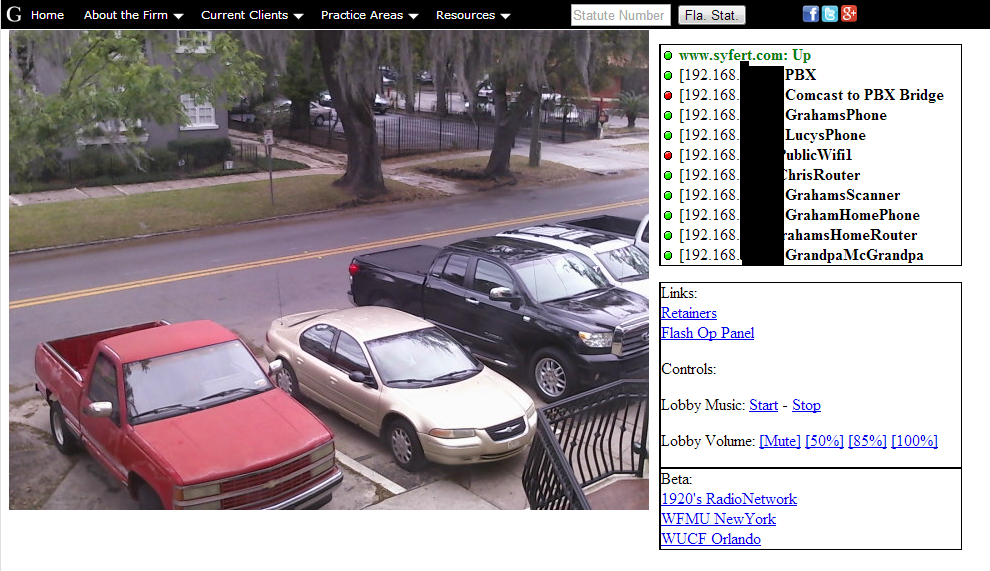
At my office, I have a webcam setup for security on a tiny linux box at the front of my office.   The page for the webcam gives me the status of certain servers and devices that I run using ping or curl.


The page for this webcam setup is a public webpage, and there is no password to access this particular page.  It is a secret known only to me, not available in any google search, but if you knew to type in the URL the public at large would be able to access it.    If someone was lucky enough to find the publicly accessible portion of this page, which is everything to the right of webcam picture, then they could have certain control over my office.  However, there is a password on the webcam stream, and so the image would not be accessible.

Over to the right hand side, there are also controls for the lobby music.  Again, these are publicly available controls.  You can turn the lobby volume up, turn it down, change the channel. stop it, start it, etc.  If you found this particular page, without a password, you would be able to create some havok in my lobby.  You would probably not be able to use this information in anyway, but it is a control of a device through the internet.

If someone found this webpage, and spent all day turning the music in my lobby up and down, and switching stations, I would be very annoyed and angry, but this would be my fault.

CFAA is not a license to be insecure

Now, imagine that weev found my webcam control page, and started spending a lot of time changing my lobby music at random (which is not all too far fetched).   I would and should have no recourse against his actions.  While it was not expressly permitted by me, by putting this control on the World Wide Web, unpassworded, I have opened it up for the world.  I do not need to list it with google, I do not need to share the URL.  If it happens that the URL is hit, then the URL is hit.  Again, I should have no recourse.

Now imagine that weev started saying things to me like, "Hey man, nice suit.  Jerk face." and started saying that he could see me walking into my office.  Well, to access that particular part of the webcam, the video stream, he would need to get around the password screen that pops up when the page is opened.  This is a line that shouldn't be crossed.  For the bar exam, one of the things we always had to remember for Burglary was that at common law, it was "Entering the dwelling house of another" and "at night" and "with the intent to commit a felony" but we have no such straight principles within the CFAA.

This lack of bright-line rules within the CFAA and a lack of understanding of technology (or a lack desire to understand) on behalf of some members of the judiciary, leads to a position where the knowledgeable prosecutor can pull the wool over the courts eyes.

Part of the lack of bright-line rules comes from the inherent problem of accurate language required by statutory construction paired with a lack of understanding and fear of technology.  And, lets face facts, the common law does not exactly seem to apply nor basically even shed light on the issues presented by technology.  The law of trespass has been used to describe entry upon land for centuries.   States have instituted laws regarding the posting of signs regarding trespass.  There is no "Signpost" on a webserver where such trespass warnings can be instituted.  There are only password prompts or denials of access.  It is not the "World Wide Web" of secrets, it is a world wide web of publicly accessible information with nests of secrets all around.  If you want your information to be secure, and for a potential intruder to be criminally or civilly culpable, then it is your duty to put up sign posts or passwords, no matter how simple.  Access to this information should be restricted, and secured, so that actual intrusion becomes necessary to get at the information.

If I place upon my server a public directory, lets say http://www.syfert.com/AB34392DQERE3, it is a good chance that this would never be guessed.  But if I start throwing information into that folder without placing passwords on the information and someone accesses it, it is my fault.  I put the information on the web.  But, if I went to a judge or a prosecutor and claimed that you accessed that directory without permission and gained valuable information, I might be able to get them to run with it.  If the Prosecutor or Law Enforcement had some particular reason to hate you (i.e. you are very vocal in a political party or movement or just being a general jerk like Weev) then they would spin the story into a security breach and seek punishment.  The lack of direction within the CFAA and the lack of understanding of technology have lead to the perfect storm of selective enforcement of the law.


TAKE ACTION TODAY https://action.eff.org/o/9042/p/dia/action/public/?action_KEY=9005


Tuesday, March 26, 2013

Bait Productions Pty. Ltd. v Does 1-XXX - IP Enforcement Law Group


Attorney Richard Fee of the IP Enforcement Law Group PA has initiated many multiple individual suits in the Middle District of Florida.


Bait Productions Pty Ltd. v. Doe 3 - Filed 2/11/2013
Bait Productions Pty Ltd. v. Doe 24 - Filed 2/8/2013
Bait Productions Pty Ltd. v. Doe 24
Bait Productions Pty Ltd. v. Doe 12
Bait Productions Pty Ltd. v. Doe 33
Bait Productions Pty Ltd. v. Doe 37
Bait Productions Pty Ltd. v. Doe 52


No client I have ever talked to about this movie ever remembers anything about it.  http://en.wikipedia.org/wiki/Bait_(2012_film)

The IP Enforcement Law Group is tightly integrated and an alter ego of Fee & Jeffries, P.A.

IP Enforcement Law Group -

IP Enforcement Law Group, P.A.
1227 N. Franklin Street Tampa, FL 33602
Phone: 813-490-6050
Fax: 813-490-6051


Fee & Jeffries, P.A.
1227 N. Franklin Street  Tampa, FL 33602
813.229.8008


David Jeffries is a partner in both firms.


Monday, January 28, 2013

Malibu Media - Exculpatory Evidence Request


Malibu Media is contacting John Doe defendants in cases and requesting that they fill out a document, under oath, called an Exculpatory Evidence Request.


This document is a strange request for discovery without proper form before the courts.


If you are in Florida or Georgia and have received one of these Exculpatory Evidence Requests, please do not hesitate to call.

Saturday, January 19, 2013

Georgia Super Speeder - Class Action

Graham Syfert is currently taking contact information from potential clients interested in Georgia Super Speeder representation.

If you are a resident of Florida, or any state other than Georgia, and have received a notice which states that your license may be suspended for a failure to pay an extra $200.00 on top of your traffic ticket, Mr. Syfert is currently putting together a list of clients for a possible class action suit against various entities within the State of Georgia.

The first thing you will need to do is visit https://www.foreclosurelawyerjacksonville.com/contact.php
 and enter your information.

Second, please gather the materials that you have collected (Your ticket, any letter or demand for payment provided by DDS) and provide it to Mr. Syfert at graham@syfert.com or fax it to 904-638-4726.  By submitting your information, no attorney client relationship exists, but attorney client confidentiality does.  This is not a guarantee that any case will even occur, but collection of this information is the first place to start.  Mr. Syfert intends to consult with other attorneys on this matter, and may enter into an agreement for joint representation with other counsel in these matters.

Of particular interest is anyone who actually had a license suspended due to a failure to pay the super speeder fine.  I would like to talk to a few people who had this happen.  Mr. Syfert is licensed only in Florida and Georgia, and cannot give you advice on how to challenge Georgia's suspension of the superspeeder law if you are the resident of another state.

I wrote an earlier blog post regarding the double jeopardy aspect of the Georgia Super Speeder law.  I hope to challenge this soon in a criminal matter.  While researching the matter of the constitutionality of the Super Speeder law, I came across something interesting.  The legal theory is still being developed, but I don't see any reason why it is not a good argument.

My Grandfather died on I-95 in South Georgia.  He is someone that could have benefited from the extra revenue the Georgia Super Speeder law (O.C.G.A. section 40-6-189) .   He would be rolling over in his grave if he knew that there was another fine on top of a fine that was already paid.


Tuesday, November 27, 2012

West Coast Productions, Inc. v. Does 1-448

Robby T. Cook - Attorney at Law
3:12-cv-01277-HLA-JRK
West Coast Productions, Inc.


Another Porn bittorrent case.  This time targeting 448 People.   

At the risk of sounding like an advertisement, contact me today for representation.  As always, the consultations are free.

Thursday, November 15, 2012

Bait Productions Pty. Ltd. v. John Does

An attorney by the name of Richard E. Fee of Fee & Jeffries PA has filed more than a handful of lawsuits in the United States District Court for the Middle District of Florida.

The Plaintiff in this case is Bait Productions Pty. Ltd. and these (now fourteen) cases target on average about 50 people at a time.  As of today's date, Bait Productions Pty. Ltd. appears to have filed 14 cases, and are therefore targeting close to 500 or 600 people.  This means that roughly 100 or 150 innocent internet subscribers will be targeted in these cases.

Some of the the case numbers are listed here:

8:12-cv-02464-VMC-MAP
8:12-cv-02470-JDW-EAJ
8:12-cv-02468-JSM-MAP
8:12-cv-02466-MSS-MAP
3:12-cv-01205-MMH-JBT
6:12-cv-01637-GAP-DAB
8:12-cv-02556-MSS-TGW
8:12-cv-02555-JDW-TBM
8:12-cv-02554-MSS-TGW

My sense of humor means I can't help but point out the two parts of these cases which are naturally funny.  First of all, in the movie Dragnet (1987) starring Tom Hanks and Dan Aykroyd there was a pornography company named Bait.  Dabney Coleman played the part of a Satan worshipping pornographer named Jerry Caesar who ran the company that produced Bait magazines.  The portrayal of a rich pornographer in his mansion by this star of Short Time is how I like to think they all live.   Notice how Dabney Coleman is the victim of a crime, just like pornographers who have their content stolen online.

The second part of the cases which is naturally ironic is the term "Bait" which of course is what is happening in these cases.   People are being baited, and whether they are guilty of copyright infringement or not, people will be extorted for larger amounts than are fair and equitable, or in the case of the innocent internet subscriber, simply extorted.  

Bait Productions appears to be an Australian company and to have made a movie called "Bait".  They have had a registration in Australia since 2010.   I have not seen much movement on these cases at this point, but it is certain that the demands and notices from the ISP's will be coming soon.   Just in time for Christmas.  Ho ho ho.    http://www.imdb.com/title/tt1438173/

From IMDB :A freak tsunami traps shoppers at a coastal Australian supermarket inside the building - along with a 12-foot Great White Shark.  4

5 Stars.

As always, my website www.syfert.com contains the FAQ which is still relevant to all John Doe cases. 


Thursday, September 13, 2012

Lightspeed Media CFAA Lawsuits and Guava v. Skylar

Let's call things like they are in the Lightspeed Media lawsuits.  People are using web browsers to access pornography through a website.

They generally get to these websites by using "porn password" webpages when looking for free pornography online.  Sometimes these passwords are included in a URL, for example http://user:password@URL.com/

Generally, the people who run these websites make their money off of advertising, and obtain their passwords from a wide variety of common hacking methods.


Tuesday, August 7, 2012

Comcast Granted Interlocutory Appeal in Nationwide Jurisdiction ISP Subscriber Information Case


It is a rarity among the federal courts for an interlocutory appeal to be granted in an issue regarding early discovery, however, it appears that Comcast has been granted an appeal as to the constitutional issues regarding jurisdiction and joinder.  

It should be noted that Comcast must have put up a substantial fight to get Judge Howell to grant an interlocutory appeal on these two issues, and attorneys from Comcast believe they will have some measure of success at the appellate level that they have been unable to achieve in the District court.  


The order by Judge Beryl Howell is located in the link above.

Comcast lawyers will be arguing the points originally raised in my Motion to Quash and Motion to Dismiss forms that I posted nearly two years ago, but with decidedly more elaboration, I hope.

We may soon have a ruling from an appellate court regarding jurisdiction and joinder at the "John Doe" level of the bittorrent lawsuits.

Wednesday, August 1, 2012

Cloud Computing and Attorney Ethics: Virtual Files in the Ether and Sharing with Laypersons and Laycomputers

Can attorneys work in "The cloud"?

A recent article in the Florida Bar News, August 1, 2012, written by Gary Blankenship brings up an interesting problem being discussed by the Bar's Professional ethics committee regarding the confidentiality of client information and the use of cloud computing.

"On the cloud computing issue, committee members said there are concerns because attorneys are placing confidential client information in the custody of third parties. . . . "This is an emerging area that lawyers are reading into without any idea of what they are getting into," said Steven Teppler.  "There are no guidelines, because there are no standards out there for security, and there's no real way you can do your homework to be sure you are comporting with the ethical rules."

The article also stated that it was unlikely the committee would rule that cloud technology is improper to use, but that regulations needed to be put in place.

Judge Jim McCune in Marion county summed up the issues best when he stated:  "There's a lot more to [the ethical issues] than meets the eye.  Cloud computing gets outsourced to India and other places, and there's issues about whether you can repatriate your data that has been sent to those foreign places.  Really, we all need some guidance on this."

When the HIPPA act was produced, technology was at its infancy.  HIPPA has been a blessing or a curse to many within the health care industry.  It created numerous regulations which has lead to numerous impractical and unforeseen results due to overbearing policies that do not change along with technology.  Other than just another pointless rumination within a blog post, the purpose of this article is at least voice a protest in the event that knee jerk reactions to ridiculous results in the future, and to avoid the costs of regulation and increased technology costs for law firms.

What is the Cloud, really?  

The "Cloud" is a buzzword designed to create excitement around ye olde internet.  Even though it is a buzz word designed for the sale of products, it is no different than the internet of old.  Every Florida bar member who conducts business through e-mail by logging into a Yahoo account or Gmail account is already conducting business in the cloud.  If you use that e-mail account to communicate with clients, then you are using cloud based storage of confidential client communication.

In fact, if you have an internet line running into your office, and it is connected to computers that use the internet for research you are using "the Cloud."  If you use the internet for research through sites like Westlaw or Lexis-Nexis, you are leaving tracks behind (your browsing history) and these tracks are in possession of Westlaw or Lexis-Nexis's "cloud."  These searches could reveal confidential concepts and ideas pertaining to defenses of cases, and if these are labeled by case or client, as is such a feature on both websites, Lexis-Nexis and Westlaw could be storing more information about intended litigation arguments and issues than would be noted in a typical client file.

Cloud computing, in general, is based in the idea that as internet speeds increase, entire programs can be run from a web browser.  The content created with those programs, can be stored remotely, and generally gives options to create a local copy.  Soon, with the increase in speed, we will see a world where the installed software on a PC will be limited to providing access to the internet so that cloud based applications can be accessed.  Although they will be much more powerful devices than the dumb terminal, of old times, the essential concept of the computer being simply a conduit to display information from other more powerful computers is the same as a "dumb terminal."  The benefit of the cloud is an expected savings to the consumer by replacing the need to host a server, purchase software.   It provides for easy collaboration, and easy access, generally, from multiple kinds of devices.

Even though the concept behind the cloud is new, the technology that drives the ideas behind "the cloud" is nearly fifteen years old.  However, due to slow internet speeds, these products and programs were not feasible for use by the general public.   Because the technology and idea behind cloud computing is "old" (in technology terms) it has solidified for me that "Cloud" is a buzzword.  The popular adoption of the term "Cloud" is simply a word for "Data stored on the internet, not stored on local drives."

Common Cloud Services

Cloud services are in their infancy.  Currently, most Cloud services are used for backup of local data.  As time progresses, more and more edits will be done remotely on that data by web applications.  These would include Dropbox, Google Drive, iCloud, and other related services which allow for the storage of documents.  iCloud use to operate differently than it does now, as the "iDisk" portion of that service has now been removed and they have switched to more of a "Google Docs" approach.  Google Docs on the other hand has changed their service to be more like the now defunct iDisk.

Backing Up Data

Guidelines regarding the backing up of data on a webserver do not exist currently for attorneys.  Many attorneys are looking more to the cloud to share information.   The key issue of the security of data lies in the ability to encrypt transmission and communications.

One brief real world illustration of potential pitfalls of cloud computing:  I created legal forms which I sold for $19.95 to anyone interested in purchasing the forms.  Because I first designed them to be shared with attorneys, I placed my documents onto Google Docs so that other attorneys could have free reign to edit and copy the material as needed for their particular case.  The documents that I uploaded to Google Docs were shared among a large group of attorneys, for anyone to edit, share, or collaborate on.

An attorney in another state then used Google Docs to make changes to my motions, adding his client name, the case number.  Because Google Docs automatically saves the changes, his online edits were published to any and every other attorney that had access to the forms.  Ultimately the changes made by the attorney to my documents were to become public record in litigation, and I am a disinterested party but the real world example illustrates a need for file permissions.

Two common sense rules that emerge from both of my comments:
1)  All data that is concerning client information transmitted over the internet shall be transferred, in secure fashion, using 128 bit or 256 bit encryption for transmission.
2)  All data concerning client confidential information should be set with permissions so that it is only accessible by employees of the firm.

HIPPA pointed out that e-mails or web traffic sent which contain patient information should be encrypted.  See http://www.ama-assn.org/resources/doc/psa/hipaa-phi-encryption.pdf   Along those lines, they have also suggested that the method of storing data should be such that it is in an encrypted form.  They make suggestions as to the encryption of local folders.  The publication I linked, also contains information concerning the fact that if transmissions are encrypted, and if local documents are encrypted, then a security breach does not need to be disclosed to patients.

In fear of HIPPA compliance, and increasing reliance on the internet, most small health practices have adopted a policy of not allowing ANY communication from their servers that is not encrypted.  Encryption, however, is good policy for data security, but if a hacker wants the data, they will obtain the data despite the encryption by obtaining the encryption key or the password which is associated with the data.  HIPPA's requirement or suggestion of local encryption of data is overkill, as local file permissions should be sufficient to prevent "casual intruders."  Most hacks concerning locally stored data will not be overly concerned with encryption (especially like Microsoft EFS) because once access is gained to the account that encrypted the information in the first place, all of that data will be decrypted.  To put it in the simplest of terms, your Yahoo or Gmail account is "Encrypted" so that others can not view it.  However, once a hacker has your email password or otherwise has access to your account, he can view all your e-mails in an unencrypted form.

Gdrive, dropbox, and other "cloud based" backup tools generally provide for encryption of uploaded and downloaded material.  They do not provide encryption of data, but they do not allow for the free dissemination of information, unless such permissions is checked.

In short, unencrypted storage of data should be permissible, even in the cloud, as long as such information is stored in a manner where it is not freely available to the outside world and steps are taken for prevention.

In the middle of writing this blog post, a fellow by the name of Bradley Wallace, in Raleigh, NC, whose number is 919-809-7121, called me.  It was such a coincidence, that thought I had to mention him.  He was calling and trying to sell me on the fact that his cloud based system, sharefile, would assist in the new e-service rules that take effect September 1st.  He began discussing about how the incoming e-mails can be automatically indexed and stored.

I began quizzing him relentlessly about the methods of encryption, and as to whether the storage was encrypted as well as the traffic.  He sweated through my interrogation with a positive attitude and confidence of a man who had been on the phone all day being rejected by Florida attorneys who were uninterested in taking on a new expense.  I include his phone number here not to punish him, but instead to say:  Hey, this guy has a product that might be ethical per se.  It is HIPPA compliant.  They are filling a niche by providing encryption of both data and traffic, and have a customized agreement suited for that purpose, unlike Google Drive.  I do not believe attorneys need a full HIPPA compliance, but I do think that if it is HIPPA compliant it would be per se ethical.  So, you Florida attorneys out there can call Bradley and see if he can show you what the system can do as far as automatic sorting of e-served documents into file folders.  I have my own ideas on the matter.

It is August 1st, 2012, and while my e-mail address is on all my pleadings, I have approximately 50 cases where I do not have an e-mail address for service on opposing counsel.  I have no belief that I will receive an e-mail address from these attorneys before September 1st.  Especially the Plaintiff's foreclosure lawyers, where in pleadings the names of many attorneys appear, but not one real point of contact.


Websites

Clients initial interaction, at least for me, generally start at my website.  I currently have about four active domain names that I am running, and only one of them has 256 bit SSL encryption.  I use this domain name that currently has an SSL certificate installed for all client communications through the web.  Needless to say, any client communication which takes place through a website should be encrypted.  It is incredibly rare for me to find any attorney website which has an SSL certificate installed.  It can cost a lot of money.

It should be equally as rare for me to find an attorney site which has a "Contact us" or "Chat now" button, but it is not.  Any site with this sort of function should For an illustration, if I look at the websites of the two top personal injury attorneys (or at least the top advertisers for personal injury cases) in Jacksonville, all of them have a "Contact us" page where client information is to be filled out.  Neither of them have their contact form encrypted, and neither of them have the suggested disclosure to potential clients, that information submitted through the website is submitted in an unencrypted form which may be viewed by third parties.

As of the time of this writing, I clicked on the "Chat now" button on one of the websites, and looked at the protocol and confirmed that the chat session that was initiated was insecure, and had no SSL encryption or other security protocols.  These "chat now" functions are web based applications which use old protocols that used to be driven by software which would be located on your computer.  Now that web based applications have been invented, they are being placed on attorney websites as a way to create more customer interaction.  Implementation, even among the most apparently wealthy and well to do attorneys, has been done in a manner of shoot first and ask questions later.  Feeling like they need to adapt or die, attorneys are paying for web development and customer interaction integration, without asking the typical questions that would normally be required.

The fantastic entity under the Florida Bar named LOMAS has issued statements regarding unencrypted communication and have been advising attorneys to disclose a lack of encryption, for almost as long as "Contact Us" forms existed on websites.  This leads to some more guidelines which are repeats of the first one, but with a slight additions and clarifications.

3)  Client communications initiated through an attorney website should be encrypted or contain information regarding the lack of encryption.
4)  This rule should not be made to require that the domain level encryption certificates are purchased, but rather that if any content or application is embedded or included in an attorney website without a security certificate, it should be sure to run over a secure socket layer.  (A chat application can be on a website that does not have a pretty green padlock next to the URL, and still be secure if it is embedded within an insecure webpage, or somehow included in an insecure webpage.)

The McCune Conundrum

I do not personally know Judge McCune, but I hope that he has a sense of humor regarding the title of this section.  He has presented, with his statement concerning cloud based computing hosted in India, an interesting problem which to my knowledge has never been faced.  However, it is indeed a possible issue, given that "storage locker" type websites are often shut down for fear that they will be used for the purposes of piracy.  By his concern over repatriation of the data, his fear seems to be that a cloud service may host data, and then decide, for any number of reasons, not to release that data back to its original source and owner.

I didn't ask Bradley regarding the question of, "Is my data safe, even if I stop paying you?"  McCune is well positioned in his fear.  As a hypothetical, take the case of a disbarred attorney who used cloud based storage.  If the attorney simply stopped paying, and digital copies of important documents were all that existed, and the client needed a copy of that document, obtaining the data could be difficult.  I could tell you one thing, however.  If the data was encrypted, and the person who had the password died, it would cease to be just difficult to recover the data- it would instead be next to impossible.  A "permission" based password system of security should be sufficient for cloud storage.  A permission based system of security should not be sufficient for cloud storage, if it is not over an encrypted connection.

For this situation to occur, it would require an over reliance on cloud based architecture, without the existence of local backups.  This is the sort of concept and idea that makes all old attorneys cringe and hesitate to embrace the future.  Communication and access to client information is key to the operation of a law firm.  Anyone who has ever handled technology for a law firm will tell you that when the internet goes down, they are hindered temporarily.  However, when the phones go down, the law firm is outraged. One Paralegal said to me, "When the internet goes down, at least our phones still work.  Our local server still stays up so that we can do work."  With the internet goes down, or access to the internet is not available, client information may also be unavailable.  Using a cloud based "backup" system should not change the local  servers information, but as we progress more and more away from local services, the McCune conundrum becomes more clear.  What this shows is that web services should not be used as a sole method of data storage.  Unpaid bills to hosting services might mean that you can not retrieve your data or that it is deleted.  Each hosting service has its own policies regarding these matters.  If I took the time to review them it would be more like the earlier commercial when I mentioned sharedrive.

Local backups solve the McCune conundrum,

Help!  My confidential client data is in the hands of a fellow in India.

I poke a little bit of fun regarding the Judge's statement that the data might be located on a server in India.  However, he is only slightly wrong, and the truth might have scared him even more.  Most "cloud" data storage isn't located on one server in India.  In fact, the confidential client data is probably located on multiple servers throughout India, and being shifted around to different geographic locations all over the world at the whim of the cloud system administrator.  I understand that that this can make things a little more scary, but it is the truth.  See how the software, "openstack" works by visiting their website.

All of these online providers generally have agreements  Google Drive states: The rights you grant in this license are for the limited purpose of operating, promoting, and improving our Services, and to develop new ones.  http://www.trainsignal.com/blog/public-cloud-storage-privacy
In the face of the license, Google Drive has reassured all business customers that their "Private" data will remain private.   Other than the license agreement which plainly appears to state otherwise, I would imagine this would be akin to a computer technician who needs to have access to all the files, and makes you sign a waiver to that effect, but does not disclose that information.

A bizzare hypothetical:  Someone decides to sue Google and stores client confidential information on their Google Drive.  Google decides to open it under the terms of their license.  I would hate to be a judge in this situation.

The uploading of encrypted files would easily satisfy any requirements for client confidentiality.  Even to Google, this files would appear to be gibberish.  File names, however, would be able to be indexed and scanned.  How much information can be gleaned from a list of file names?  You would be surprised.  As an added complication, the great reasons to use these tools (easy search of documents, quick and effective client research and drafting, etc.) would also be negated by the encryption.

Gmail and Yahoo web based accounts are commonly used among attorneys.  That information is all scanned and used to advertise to you.  Is it necessarily a leak of confidential information?  Doubtful.

Help!  My confidential client data is in the hands of a data center in Jacksonville. Or, why we attorneys might overreact about confidential data in the cloud.

 Before cloud based services became publicly available, it was (and still is) common for Data Centers to "co-locate" a machine running Microsoft Exchange.  Those who firms armed you with blackberry's at one point or another, and had frequent connection problems to their server, probably had a co-located machine.  I could, for example, take my own web server and host it at Peak 10, my favorite jacksonville data center.  (I do not co-locate my machine though, just a shameless plug for some good folks.)

They would have access to the hard drive, and all client data if they decided to crack open the machine and take out the hard drive.  Of course, Peak 10 and other reputable establishments would never do this.  It is more likely that they would offer services software which would inspect all client data to for evidence of a lack of integrity of the data.  An absolute loss of data scares me more than my data being located in India.

Currently, cloud services are outperforming my hard drives in reliability, but I would never be without a local backup.  I don't think any attorney at this point completely trusts cloud architecture to the point where he would migrate an entire business.

In essence, cloud services, and others like it, should be allowed to be your IT guy in the sky.  You should be allowed to trust your IT guy not go snooping around where he doesn't belong, or to use or abuse private information.  Same could be said of the mailman taking important documents.  "Do they open the envelope and peek inside?"

You should, however, be able to negotiate with your cloud provider, just as you could with Peak 10 or other independent establishments who do not require click to accept, one size fits all user agreements.  The necessity for manpower to accomplish these tasks means that the large cheap providers do not have the time to custom negotiate a contract with you to protect your data.

Using a data center, or a high speed internet connection, can allow you to create your own "cloud" based services, without the need for relying on "click to accept" functions.


Help!  My confidential client data is in the hands of my employees and accessible through a local server! And, I e-mail back and forth with my clients and employees concerning secure matters.  Or, why we as attorneys are generally underreacting to confidential electronically stored data in general.

This HELP! section is probably how your firm is already set up.  You are communicating with your clients via e-mail.  While you might use an encrypted connection, you have no idea if they are using an encrypted connection unless you pre-shared a key and pre-arranged the message sending.

Original messages and data stores are kept in plain text for numerous reasons.  Some of these data stores are kept on your webserver in an SQL database.  Your "Contact Us" button, might actually contact you, but it might also be storing those incoming messages in an SQL database for later retrieval, on your website, vulnerable to hackers, through your website.  If your company intranet website uses a web based data system, accessible through a browser, your client information is being stored there in an SQL database, you might be vulnerable.  As far as data interception methods are concerned, database leaks are one of the biggest security flaws and vulnerabilities that can be experienced by a law firm.   If your law firm website is on Google, it is being scanned at least three times a week for security holes by people all over the world, no matter how small and insignificant you may think your practice would be.

An attorney in Mississippi once told me a story about someone who would steal clients from him by hacking his voicemail.  He swore up and down that a competing attorney was calling after hours, and using his default password, deleting his voicemails and taking the business.  Today's equivalent might be SQL database dump like the ones so popular in the news, or even a program that would just harvest "Contact Us" requests through a website and redirect them.  An insecurely programmed site is likely to be more common, among those who paid more for features within their website.

I already mentioned the website issues regarding client communication and a lack of SSL certificate, in both the contact forms and the web chat functions.  Even for small businesses, HIPPA prevents this.  We have no such official regulation as attorneys.  Just the tiny voice of LOMAS making a suggestion.  Honestly, such regulation would probably send attorneys scrambling to find ways to comply with HIPPA, and finding that their old reliable system of case management is no longer working how they would like it.  I do not believe we should take HIPPA type measures, but I do believe that web access should be secure from intruders based on permissions.

5)  Any attorney should take reasonable steps to ensure that client information passed over the internet is passed in an encrypted format whenever possible.


Once again, we can't be sure that the client is using an encrypted connection.  The system of e-mail is to beneficial and crucial to the process of law and open communication with clients.  However, it would be a shame to abandon it just because there is no way to ensure that your client is using unencrypted web based mail, or is using an insecure port to download e-mail to his "Microsoft Outlook" at a public wi-fi hotspot.

Although it sickens me to say it, Facebook is actually a more secure method of communication with a client than if they decided to e-mail using an unencrypted connection on unencrypted wi-fi.  If clients were so inclined to be able to receive PGP messages, this would be a decent solution.  However, this is not a solution in most cases, because most people don't know how to send "encrypted" e-mails.  Implementation of such systems, right now, would be expensive and nearly impossible.


Requiring encryption of communication traffic through a website is an additional cost that attorneys do not want to incur, but such cost would be a reasonable expenditure, in light of the importance of web traffic in a law office.  The truth is that attorneys will be wary to adopt these standards unless they are forced into adopting these standards.  I don't blame them.  The costs can be outrageous from some companies who do hosting, but a reasonable amount is more like a maximum of $100.00 per year.  Depending on hosting plans, certificates can run into the thousands.  And if you have multiple websites, it is time to shell out money for those as well.

More Realistic Threats

A law firm's confidential data, stored with a nice secure long password, is more likely to be breached by an employee or someone with physical access rather than a hacker.  Ultimately if a hacker wanted to get into your systems, and monitor all your internal and network traffic, he would gain physical access to your office and install a device which would plug into your network and begin analyzing the network traffic and allow undetectable access from the outside.

My data is as safe as I can make it, but I admit, there may be something I am overlooking.  I am not as sharp as I once was regarding the details of computer security.  I have learned one thing that will not change.  If it is digitized, then it is available for someone to take, if they want it bad enough.  The same could be said of a paper file.

In conclusion

Ultimately, a safe full of paper is much safer than using computer networks to store information.  But, we, as attorneys, are going a way that congress has decided that health care can not.  Sometimes for the better, sometimes for the worst.  The rapid communication of e-mail has changed the legal practice so much that we are adopting it for service as a preference over fax and US Mail.  It has made it easier to communicate with clients, and sometimes more difficult to communicate with opposing counsel.

-------

Now, I am preparing to design a linux based automatic filing system for saving e-served documents locally, without paying anyone.  Well, maybe sometime soon.

Oh, and I would also again like to make a public apology to Bradley Wallace, in Raleigh, NC, whose number is 919-809-7121, and tried to sell me sharedrive.  Mr. Wallace who did sweat through through my interrogation about their security and emerged on the other side looking like an overall decent guy.  He just happened to have been unfortunate enough to catch me in the middle of this post.  I swear I am not getting a kick back from sharedrive or Mr. Wallace.  The timing was just perfect, and maybe this will drive him some business and payback the bad karma I gave him early on in our call.




Saturday, July 21, 2012

Is the World Wide Web unethical for Florida attorneys? Or, why the popular websites break the rules.

I grumble like an old man so often to other people about the state of websites for lawyers and how they are used.  A colleague of mine, a worthy adversary in court, got to talking one day regarding the low public opinion of attorneys and he blamed it on one thing, and said it was "Advertising"

A third person was talking about her ex-husband saying "He's in a profession that is held in lower regard than an attorney."  Both of us chimed in at the same time, and said, "What is he, a used car salesman?"

Then my worthy adversary began complaining like an old man:  "Back in the 1970's there was a ruling and suddenly attorneys could advertise all over the place.  When this competition started happening, it was no longer based on the past experiences of clients and word of mouth, but instead, it was about who could give the best impression that an attorney can give them an edge.  Something about this soured the whole profession."

The decision was Bates v. State Bar of Arizona, 433 U.S. 350 (1977).  It highlights the flipside of the argument my adversary presented.  Word of mouth makes things just too difficult to find an attorney.  An absolute ban on attorney advertising is probably too much.  Along with this decision, the many states have come down with rules regarding attorney advertising.

Attorney commercials on television are a running joke.  In states like Florida, where the ethics are strictly regulated, attorney commercials are often considered a joke.

"The music is always so boring," one friend said.
"So, if it suddenly turned up with some heavy metal in the background, would you hire them as an attorney?
"Well, no."
"What's a better idea then?"
"To make it less sucky, I don't know,"  was her reply.
I then went on to bore her with conversations about attorney advertising regulation, and the fact that in Florida, attorneys were not supposed to use exciting music, and how in Mississippi, I saw an attorney using the phrase "turn your wreck into a check" and another who used the phrase "We get the money you deserve," as their tagline until they realized what they were saying and changed it to "We get you the money you deserve."

Rule 4-7.5 limits any background sound other than instrumental music.  Instrumental music isn't by definition boring.  See, i.e. Explosions in the Sky (Texas 2003).  However, one wonders how the commercial reviewers at the Florida bar would react to some of the raucous feedback of the howling Marshal stacks if someone where to somehow obtain a license to use a song by Jimi Hendrix, or Sonic Youth.


Florida Ethics Rules regarding Social Networking Sites

The Florida Bar Standing Advertising Committee has come down with ethics decisions regarding the use of Facebook, Twitter, Linkedin and other websites.  These rules are available in full text here:  Florida Rules Regarding Facebook, Twitter, and Linked In   I will attempt to itemize them, in some sort of statutory form, but also in the style of the twelve commandments, even though there are only three.


1.   I am the Bar, by God, which has understanding that you might use social media for personal reasons, but if you shall ever use it to promote your law firm, in Egypt:
a)  Thou shall not invite, add, or friend request persons not in your current contact list, unless they are an attorney.
b)  Thou shall not send out "public messages" from social media sites, which contains links designed to generate business or solicit legal services.
c)  Thou shall not violate rule 4-7.2

Section b) of my pretend statute above, will ultimately require an expansion.  I fully intend to tweet a link to this article, when I am done writing.  Now, most of this will only be of interest to attorneys, so I am sure I am OK when it comes to this particular article.  It will be a public tweet, but only my followers will get my requests.   It seems as if using the "@" symbol behind someone else's twitter name without their permission could get you in trouble, if you are promoting a link or a website.  What about hash tagging a very popular trend?  What about hash tagging something relevant so that people can find information?  It seems as if this "public post" rule will need further clarification as technology progresses.

However, it also seems to exclude public posts, which would be searchable in twitter, which are not specifically pointed towards anyone

Inherent Pitfalls in Social Networking Sites

Linkedin

Attorneys are not allowed to declare themselves experts in a field.  They can, however, be board certified.


When I signed into my linkedin account today (which is incredibly rare) I noticed that it was telling me that my profile was at 87% completeness.  It gave me a progress bar as an indicator, which had a yellow sickly look, and desperately itched to turn green and show a stick and two goose eggs next to the percent sign.

 I looked for the portion that was incomplete:

Now I remember why I left this part blank.  It says "Skills & Expertise."  The reason I include the screen capture of this is solely because it can be funny to lawyers who understand the logical use of the word AND and OR, not to mention the ampersand symbol.   The grayed out words in the middle say, "Enter your skill OR expertise."  Florida bar prohibits the use of the word expert, or expertise, to describe services but would most likely accept "skills."   Logically, if it is an "or" Statement, then it is either a skill or an expertise, or both.  The ampersand, standing for "and", means it is BOTH a skill and an expertise.  This is how it would be seen by the general public.  Therefore, I believe, that putting criminal law or any other words in this section is inherently unethical, unless an attorney wanted to add truly unrelated skills such as kung fu or linux administration.

Facebook

First, let me confess that I don't really "get" facebook.  I honestly don't know where features are within the interface, but this isn't from a lack of computer knowledge, it is instead from a lack of Facebook use.  The most intriguing part about Facebook to me is that it is cataloging a massive database of the human experience, ranging from the exciting exchange of new ideas and information, to what someone had for breakfast that morning.  This exchange of personal information and ideas will ultimately lead to great change.


My friends on Facebook rarely see any activity from me.  My personal Facebook is a mixture of random people that friend me, real friends, and people I friend-ed.  Sometimes, if I read an article about someone that is interesting and they have a Facebook, I will send them a friend request.


While I do make good attempts to keep a clean line between my personal time and my business time, I have never made such attempts when it comes to my personal facebook and my business facebook.  I have created a business page, but that is about as far as I got. 


Needless to say, writing a script that targets people who use the term DUI in a public post, or car accident, and then reaches out to message them on facebook regarding legal services, would be improper.   The technology of http://weknowwhatyouredoing.com/ could readily be applied to this unethical enterprise, to seek out people complaining about their daily lives.  Ambulance Chasing/Facebook chasing.  Potential search terms "Hospital" "wreck".  See Danny DeVito in "The Rainmaker"


Legalzoom

The legality of Legalzoom and Quicken Family Lawyer has been decided by a number of courts to not be an unlicensed practice of law.   Legalzoom and other form sites like it, following their success, they were emboldened to go even further, and offer attorney services directly from their website.  They have set up a buffer, in the form of an attorney referral company.

The form market is a big business.  The attorney market is a big business.  Companies like legalzoom have attorney Robert Shapiro pitching for them on TV, as a spokesperson.  Their website tries to make very clear that they are not attorneys.  They are more worried about sales of a form, than whether a form will fit a particular purpose.  There is no customization of a legalzoom form other than what they permit.   Rocketlawyer, falls to this same pitfall, as do most others.


SEO Ethical Issues

I readily admit to doing stupid word link based SEO on my own sites, where I am permitted to control the content.  On other blogs, if I posted a comment, I wouldn't even think of creating a link, except to my page, but not by including a search term.

On this blog, I have noticed many attorneys who hire SEO companies to make comments like (Thank you, this will really help with my legal research) and then sign it "houston criminal attorney".  I have traced the IP's back to China.  So, there are some attorneys out there who are hiring SEO Companies who are in turn hiring chinese citizens to write blog posts using fake names and creating links to help search engine optimization.  Based on some of the comments, and their lack of relevance to blog posts, these Chinese SEO subcontractors likely don't have even a rudimentary grasp of English.

Customer Reviews

I see some law firms with 30+ reviews on sites like google places and yelp.  I do not care what kind of success rate a person has, most people do not take the time out of their day to comment about the services their attorney is providing.  How many of these reviews were solicited?

Any attorney has always known that word of mouth is the most powerful tool for bringing in business.  As things progress, "Word of Mouth" will have less to do with what is spoken, and have more to do with what is typed or otherwise recorded online.

Avvo

Don't even get me started on avvo.  I don't think that they are doing anything directly unethical, but the "Rating" system is off kilter.  Then again, I think that the Martindale-Hubbell rating system is off kilter as well.  Some attorneys have no clout in a community, and are unknown by judges and other attorneys.  These people still have and serve clients.  The best thing that Avvo has done, it has all but destroyed what used to be an over simplistic monopoly.  It adds in, for at least some portion, client satisfaction.

"Martindale-Hubbell Peer Review Ratings were created in 1887 as an objective tool that would attest to a lawyer's ability and professional ethics, based on the confidential opinions of other lawyers and judges who have worked with the lawyers they are evaluating," said Mike Walsh, President and CEO, U.S. Legal Markets at LexisNexis.  - Quote lifted from http://www.donleylawpc.com/about.html 
And since I used his research, I will willingly plug him with one of those nasty links.  colorado springs probate attorney  I don't know him, but he seems like a good enough guy.  He's AV rated, so he must be right?
The way that the quote is worded,  it makes it seem like it was designed to help judges discuss whether a lawyer was able or ethical.  But let there be no mistake about it, Martindale-Hubbell Peer Review ratings were designed for the public, for the purposes of advertisement, and seem to me like they should be included in rule 4-7.2 's restriction on the characterization of services.

It also seemingly promotes the "good old boy" system where the losers and winners are picked from within the community, and not by the consumer.

A new commandment should be issued:
d) Thou shall not use a scale from one interval to another interval, to define the characteristics of an attorney.

Avvo is based on a game theory, to achieve the goal of a 10.0, or a level 15 contributor, and has many attorneys running around like hamsters in wheels.  The whole thing smacks of role playing.  "My attorney is a level 15 contributor to avvo with 40 hit points, 10exp and 1 magic."  I know you're thinking I'm a role playing geek right now, but I am proud to say I was thrown out of every role playing game I was ever asked to participate in.

The Solution

I see so many emerging websites and dangerous trends for attorneys on the web.  Some of these amount to very complicated profit splitting. None of them are truly adequate.

What is needed is a website where an attorney will be able to control his content, sell his own forms, and offer his own services for review, cutting out the middleman.  Advertising alone could be worth hundreds of thousands.  It could combine the best of all services, but provide for content from attorneys, allowing them to interface with the public and sell their own materials rather than reviewing a legalzoom contract or a rocketlawyer contract.

Preferrably one with a consumer only based rating system or none at all.  Rating the FORMS of an attorney should be much better than rating the CHARACTER of an attorney.

And now that I look back on the post, I am already a little wary of my Avvo rating slipping from negative commments, and Martindale-Hubbell not letting me be peer reviewed.